All the big guns want an iPhone killer. Even I, mad for all things Apple as I am, want an iPhone killer. I want smart digital devices to be as good as mankind’s ingenuity can make them. I want us eternally to strive to improve and surprise. Bring on the iPhone killers. Bring them on.
YOU might, somewhere along the way, have picked up the impression that I am a passionate Mac advocate: I bought my first 128K machine in 1984, the second Macintosh to be sold in the UK – at least so I’ve always maintained and believed (the first went to the still desperately missed Douglas Adams) and I have never had fewer than ten working Macs on the go since the late 80s. It is true that I value both the platform and the hardware, that I admire the imagination, flair, elegance, quality and pioneering spirit of the Apple corporation. All quite true.
HOWEVER……..
I have, over the past twenty years been passionately addicted to all manner of digital devices, Mac-friendly or not; I have gorged myself on electronic gismos, computer accessories, toys, gadgets and what-have-yous of all descriptions, but most especially what are now known as SmartPhones. PDAs, Wireless PIMs, call them what you will. My motto is:
I have never seen a SmartPhone I haven’t bought
After all, the Mac itself was founded on a notional smart device, the Dynabook, fruit of the many brains of the legendary Xerox Palo Alto Research Centre (PARC). The Dynabook concept gave us the WIMP user interface, (Windows, Icons, Mice, Pull down menus) and thence the Apple Lisa and its successor, the Macintosh. The Dynabook was a posited form, a notional device that would deliver information to its user with the greatest ease and intuitive functionality. As a result of this mission statement, the command code line found in all standard computing of the time was made to yield to a Graphical User Interface (GUI). Apple took up the call (poached some PARC staff) and produced the Mac OS; IBM and latterly MS took years and years to get the message. But that is how the GUI was born, out of a quest for a better relationship between man and machine, individual and digital device.
Whether you talked into it, stroked it, operated a stylus or pointing device the essence of the Dynabook was not that it might actually be built (technology in the 1970s couldn’t begin to provide such an object, nor indeed can it now) but to predicate a useful Platonic Ideal. The Device. The Chosen One. One Electronic Object To Rule Them All. Like any Platonic ideal, it cannot ever exist: to postulate its existence is enough to set clever people on the right path to creating remarkable technologies that contribute to the digital world and our interactions with it. It is in this sense the computer designer’s Holy Grail – the adventures, romances and interior quests along the way are what counts – the Grail itself will always be out of reach. We are getting closer however. A single handheld device that can summon up a vast repository of human knowledge, communicate with anyone, tell you to within five meters where on the planet you are, take and show photographs, record and play music, send and receive vox or data communications; a device you can speak into and that can speak to you, a device that you can manipulate without fiddly controls or technical knowledge, a juke-box, a cinema, a radio, a library, a community centre, a parish pump, the school gates and the city university. Not considered to be computers, although computers is most assuredly what they are, these devices are for the moment designated SmartPhones, and it is on them that I wish to discourse and expatiate in an entirely disinterested (if you think I mean uninterested, think again and look up the difference) and mostly non-technical way.
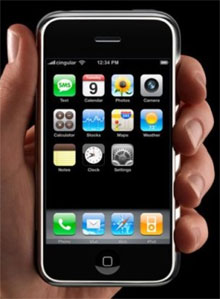
Of course, this essay, if it can be described as such, is a response to the rise and rise of the SmartPhone, as most publicly trumpeted a few weeks ago with the arrival of Apple’s iPhone. I am not here to laud or review that device however, it has had enough publicity and I really want you to believe that, Apple addict as I am, my eyes have always been open to the virtues of anything good, exciting, functional, elegant, pleasing to use. In fact the real precipitating reason for writing this is the fact that within three weeks I have bought/been sent, aside from my iPhone (which, yes, I dearly love), three soi-disant ‘iPhone killers’ – the HTC Touch, the Nokia E90 and the Sony Ericsson P1i. While I don’t intend fully to review, road-test or benchmark each device (as if I could, anyway), I do want to share my thoughts about where these devices appear to be going. (I’m not even going to mention outside these parentheses the LG Prada phone, that’s an iPhone beater in the same way Tim Henman is a Federer beater).
One more thing: I’m writing this in short bursts of time between filming in the middle of rural Norfolk, where GPRS, let alone EDGE, is a rare, momentary treat. This means I haven’t been able to check up on all my facts all the time: sometimes a tethered modem DUN connection allows me to jack into the matrix, but mostly I’m in a field fondly fingering a phone. There will be errors here. Forgive me. This is a blog, not an article and I haven’t time to get home in the evening and do much more than check the hyperlinks, such as they almost randomly are. You aren’t paying for it. I’m human. So, let’s slip in a SIM, power up and see what happens.
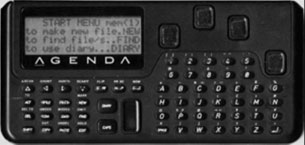
My obsession with SmartPhones began many, many years ago. Certainly well before such devices existed in the real world. From the first Sharp contact-and-calendar “electronic organisers” , through the early Psions, the sadly missed AgendA (see above: no QWERTY there, more a kind of weird courtroom stenographer’s chord-based input pad: never have I been able to write faster than with that splendid object – I had another device using the same input system called, I think, Qinky, which connected to the Centronix port of a BBC Micro), to the opening salvo of Palm Pilots, Apple’s Newton and the arrival of Handspring. If they existed I had to have them. Had to. Some could be used with a phone: they might generate dial-tones for example, or somehow, like the later Psions, come with the optional extra of an infrared modem that could shake hands with a Nokia mobile phone and put one on the path to something approaching what today we might call a SmartPhone experience. Those infrared modem scripts still lurk in the system preference and plugin files of even the most up-to-the-minute computer, like a Kodak Instamatic in the back of a drawer. Obsolete, but too charming to throw away. And you never know – one day you might just need them …
There is always, in the way of these things, a model that’s just right. The Psion 3, the Treo 180 — such close-to-perfect devices are always overtaken by newcomers that arrive shimmering with newer technology and higher functionality but don’t do what they do as satisfyingly, as perfectly, as their predecessors. The brilliant Psion 3 was superseded by the inferior 5 series and then the not-quite-up-there Revo (which I helped launch, I have to confess: maybe my fondness for the Series 3 is felt for the Revo by these people, they certainly seem very keen), and pretty soon it was goodbye Psion plc. Another pioneering British company founds a whole niche and then bites the dust.
But Psion, British, innovative and doomed certainly, did leave the world a lasting legacy aside from the new marketplace itself – an operating system that still does its stuff in over a hundred million phones. Originally called EPOC, its ARM processor power (it addressed more bits in its day than most people’s PCs) and simple elegance has evolved into the complex organism known as Symbian, like Bluetooth a largely Scandiwegian/Japanese co-owned entity.
In the years that followed the demise of Psion and the to-ing and fro-ing of Palm, (the US early leaders in the field), a number of things happened. Cellular telephony went from GSM to GPRS to EDGE to WCDMA, HSDPA, UMTS or whatever we like to call 3G these days. Microsoft introduced a cut-down Windows for PDA/SmartPhones, one with stylus operated touch-screen, one without, the RIM Blackberry came on the scene with its business oriented push email and the whole market went from niche to general. Bandwidth and memory ceased almost to be an issue and those of us who had once spent hundreds on a 256MB Compact Flash looked in amazement at the cheap 2Gb thumbnails hanging in blister-packs from any old airport Dixon’s.
Palm split itself in two, reluctantly (IMHO) retaining the Palm OS in the shape of the excellent 650 and the wildly disappointing 680 and allying itself big-time-stylie with Windows Mobile, all of which devices (again IMHO) more or less stink. Since then, in one of the most astonishing public suicide attempts in the history of this industry, Palm have produced a item that EVEN I DO NOT WANT, the Foleo. If it’s got a chip in it, and a keyboard, and WiFi and a screen and I haven’t sent off for one, then by God you’d better believe it’s in trouble. Though mind you, knowing me, I probably would have bought one in the end. Palm, however, have come to their senses, swallowed their pride (and $10 million) and ditched the dreadful thing, as their CEO’s blog recently revealed. Maybe Palm have finally realised that what those of us who have used, abused, loved and lived the original Treos yearn for is a fast 3G, WiFi and FULLY PALM OS Treo 800 or whatever they’d want to call it. The newish 755p would be an acceptable stopgap – high speed, better battery life, keyboard response and imagination behind it than the pitiful 680 – if only the damned thing weren’t tied to the CDMA EvDO protocol, which is useless in Europe. Give us our Treo 800p, GPRS/3G phone and we will love you for ever. For the Palm OS, ageing as it is, still has something of an edge over its competitors. Superb address-book design and functionality (still the quickest way, from the draw, to find a name out of 2,000 and call it, text it or email it on any device I’ve ever seen, is on a Palm. Blackberry comes a pretty close second in my unscientific tests), next there is its sheer speed as a GUI. Never a hint of a screen redrawing, never any lag (not counting the 680’s irritating address book line drop – if you’ve got one you’ll know what I mean, if not, it’s too complicated and dull to explain), this is a stable, lightning-fast OS (as unlike Windows for Mobile or Windows for SmartPhones as you can imagine, therefore). Add to this the inestimable pleasure and benefit of SMS threading (it simply STAGGERS me that no one until now, with the arrival of the iPhone, aside from Palm, offers this, to my mind, essential feature, something that’s been available on the Treo since the get-go), a good Today screen, fabulous speed-dialing options (including one button URL and texting – great for AQA, for example) and related calendar functions, simple flexible bluetoothing (though it’s a bugger to get one to work with a Tom Tom or similar in-car B’tooth device), all the media requirements, a really fast keyboard which (surprisingly, for it looks fiddly) allows about the same text entry speed as a Blackberry 8800, superb syncing with either PC or Mac, neither favoured over the other, and you’ve got the ideal package. It’s been around a long time, a very long time for the digital world, testament to the imagination, foresight and brilliance of its first engineers and designers. But that also means that the old girl is showing her age. I’ve been syncing, disabling conduits, deleting unwanted duplicates and generally faffing about with Palm devices for well over a decade and I have a very, very soft spot for them. How dumb of them therefore to reduce the quality with the 680. Worse battery life, no longer the inestimable pleasure of an exterior SIM slot, irritating reassignment of keys, slow boot up time, absence of reset button – etc etc etc.
So we’ll leave Palm, hoping that they won’t be squeezed out by the big boys and by their own suicidal tendencies. They have no iPhone killers at market as I write. We’ll believe in the idea of a Treo 800 when it comes. If they upgrade the OS, fully commit to it and ditch nonsenses like the Foleo I see a real future for Palm yet. Admittedly it has barely penetrated the European market, but worldwide and in the USA especially it has a real presence and a strong and committed user base.
HTC and the No-Win Mob
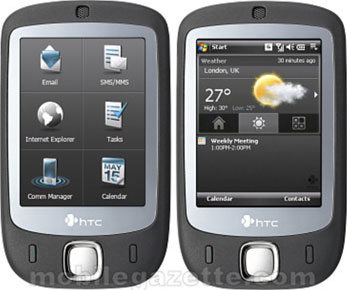
Let’s look at the WinMob now. The HTC Touch is called (by idiots) an iPhone killer because it comes without a keyboard and makes a brief and rather feeble nod towards the idea of a strokeably operated touch-screen offering a silly cube transformation effect with big buttons. Oh, and the Touch is WinMob 6 rather than 5 (you won’t notice the difference – a quite cool coloured line fribble in the agenda which shows you which days of the week are busy is the best addition, otherwise it’s virtually indistinguishable from WM5). In theory you can remove the SIM card without dislodging the battery, but in practice springing it out causes a reboot anyway. But that’s it, 2MP camera, no to 3G, WiFi/WLAN capable. The thundering nuisance of the Touch is that it encourages one to use the side of one’s thumb, the fat of one’s finger, one’s nose etc etc, all of which work with the big buttons – but when it comes to text entry and innumerable other choices, sure enough, the old thumbnail has to be ready to go behind and hoik out the stylus. It is not badly designed at all, most people who have seen me playing with it are impressed and want one, which is some kind of a test, I suppose. The front page weather app is pleasing (owing a lot as it does to Apple’s bundled Dashboard widget, see the pic above). Otherwise the Touch is nothing like as good as the HTC 3600, which is a true 3G, inbuilt GPS, elegant, keyboardless device of more power, flexibility and purpose. Far and away the best WinMob device I’ve seen, it’s good to look at, reliable and genuinely usable. Input, as with the Touch and all WinMob stylus devices, is via a choice of handwriting recognition (including the old Palm Graffiti rebadged as Block Recognizer, which competes with a virtual keyboard and two other systems). HTC are bringing out a 6300 (aimed at “enterprise solutions,” yawn, yawn, yawn, yawn, yawn) which looks identical to the O2 and Orange badged versions of these things, a Windows button, an OK button etc., dull silvery finish, the usual bad design that “corporates” always seem prepared to put up with, as if they’re embarrassed and ashamed by any stylishness which might draw attention to them. The SmartPhone equivalent of living in a block of modern flats. Most mod cons, but no style, delight or emotional attachment to be had. Windows for Mobiles is certainly better than Windows for PCs or, God help us all, Vista, but it is still an insulting offering. The feeling, as with all things Microsoft, is that all design features and functions are there to suit MS rather than to delight, enthuse and compel the user. Compromise, short-cuts, inconveniences, vestigial residues – no one responsible is likely to pat themselves on the back for the design or the s’ware engineering, any more than the architect or project manager of a 60s council flat is likely to point it out with pride as he rides by with his grandchildren. You’re only on this planet once – do something extraordinary, imaginative and inspiring. That’s the difference, ultimately. Those behind Palm OS and the Psion can justifiably be proud of what they did, what they created. WinMob just muscled in on a market they never spotted and they did it in a clumsy, bullying, ugly manner, exactly as they had with Windows before, and exactly as IBM had with the PC itself a decade earlier. Break free, all you corporate software engineers and designers: the excuse that you are under the rule of dullards, greedy share-price number crunchers and visually and ergonomically illiterate yahoos is not good enough. Persuade them. Otherwise we all get a digital environment that’s a vile as a 60s housing estate.
Syncing Issues – A Sidebar On WinMob devices the syncing software, an almost useless PC app called ActiveSync, allows no control over the syncing process and therefore gets any power user into trouble with duplicates, the bane of our lives. Much better, if you’ve a Mac, to invest in Mark Space’s Missing Sync for Windows Mobile, which has just had a round of upgrades that cope well with the HTC Touch and other WinMob 6 devices. Those of us who fiddle around with Plaxo, Google Calendars, and other server-side apps and utilities really need to know what we’re doing or we can get into the most awful pickle with our address books and calendars. Essential to have the ability to guarantee priorities and overwrites. Any Mac user who plays as much as I do has been forced to try every variation of Bootcamp, Virtual Machines and actual real, live PCs as a means of syncing and controlling their various SmartPhones. My conclusion is that as far as WinMob devices are concerned it’s better to stay in Mac OS and look for iSync plug-ins and third party apps. Nokia and Sony Ericsson have reasonable PC Suite software that justifies a visit to a PC or via Bootcamp or Parallels for Mac, but with WinMob, stay away from the truly insulting feebleness of ActiveSync. I have spoken.
Sony Ericsson
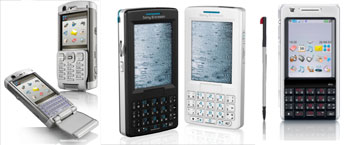
The very nice people at Symbian (the OS that arose from the ashes of Psion’s EPOC, remember), hearing through a mutual friend of my passion for all things mobilic and phonular, sent me the new Sony Ericsson P1i, which is only just out in the world. It’s pictured above there in the middle, between its parents. I’ve owned and used two P990i models (that’s the daddy on the left) as well its forerunner the P900, the 910 and one M600i (that’s the mummy on the right).
What the family have in common is their commitment to one of Symbian’s two major platforms. I mentioned that Symbian as an OS had evolved since its EPOC days – the two chief sub-species are called UIQ and S60 (there’s another called MOAP which needn’t worry us, as it’s only used in Japan so far as I can tell. As a matter of fact, it’s my washpot) … if you try and download a Symbian application, WorldMate for example, you’ll find it comes in those two Symbian flavours (as well as in Java and Palm and WinMob of course) UIQ stands for something like User Interface Quartz and S60 for System 60. Go figure, as they say in America. Well, Sony Ericsson in the “i” series of SmartPhones as shown above has gone big time for UIQ. Nokia, as we shall see, has thrown its might behind S60.
The 990i, when it came out to replace the 900, boasted 3G, a 2MP camera, WiFi, memory stick, bluetooth and a new rather impressive all singing, all dancing UIQ environment. But it was also big. Almost 1980s sized, or so it seemed next to the Slim Jims that were becoming popular amongst standard mobile phone users then (two and half years ago, a lifetime in this world), with a not very satisfactory flip phonepad which swung down to reveal a hideously unusable QWERTY keyboard. Full function wasn’t possible with the flip pad up (although I liked its four-way navigation buttons, which complemented the left side thumb-wheel superbly), yet with the flip down in full-function mode you were staring at the waste of space offered by the awful keyboard and depending wholly upon the stylus and (admittedly impressive) handwriting recognition. Battery life was a joke (a major problem with UIQ) and worse still stability was a huge issue. This thing crashed more times than an Italian dodgem car; actually it didn’t even have the dramatic wit to crash, it just hung and wasted your time. Plus it had an internet/access point/wifi set-up system that made you want to weep, stamp your feet and disembowel the team responsible.
But then along came the M600i (on the right above, also available in White, as used by Bond in Casino Royale). More elegant, pleasingly turquoise highlights, same UIQ GUI but this time a QWERTY keyboard in which each key does office for two letters (not unlike the slightly later Blackberry “Pearl” 8100, but with nothing like as elegant and useful an implementation). 3G, but without camera, so no videocalling, and no WiFi. Result? a slightly handier, but ultimately less function-rich object than its big progenitor, the 990i.
The rumour flew around that something new was in the works combining all the power of Daddy and all the elegance of Mummy. We couldn’t wait. This will be the Big One, we thought, the justification and apotheosis of UIQ.
Mine arrived at the beginning of this week. What a crushing, lowering, fury-inducing disappointment. Just how dumb are the software engineers, designers and marketeers at Sony E? Believe me, I so wanted this to be good. Instead, it is nothing more than a gesture, an under-considered, badly implemented nod at the market. It’s an M600i running Symbian v 9.1 and UIQ v 3.0 equipped with a camera and WiFi.. That’s it. No attempt has been made to alter the UI or the OS. The result: the clumsiest, most asinine method of internet connection ever devised (yes it has a wizard to download your network’s APN etc., but that’s not enough) comes unaltered, the bugginess and the slowness too have all have been inherited, and the short battery life. Did they really think slinging on a 3.2MP camera and WiFi would make a desirable device, let alone an iPhone killer?
I could issue forth quires of intemperate fury on the subject of how bad internet account configuration is on the UIQ Sony Ericssons. It’s utterly pointless. Is there not one person at either Sony E or Symbian who themselves uses the phone and says “hang on, we could do this better”? That’s all it takes. Just one person to point at the Emperor and shout “nudie!” That’s why Apple is Apple, they have people there (and of course it comes from the top) who say – “woah, not good enough, not cool enough, not simple enough, not fun enough, not sexy enough, not clever enough, not useful enough”. The P1i is what happens when “oh, that’ll do” becomes the corporate motto. UIQ promised something, the actual GUI is reasonable, in fact quite delightful, but it needed refinement, it needed acceleration and it needed flair. Instead we’ve got a very, very slow device that eats power, is difficult to use in varying environments and frequently hangs and crashes. In a word unusable. And I can just hear them hiding behind the excuse of “price” and “sectors of the market” and other bullshit. What, Apple’s a bigger company than Sony? Got more muscle? What muscle it has got, it got from daring to be better. That was once true of Sony too. Of Ericsson I cannot speak …
Don’t these people get it? A new sidebar coming on …
Design matters By design here, I mean GUI and OS as much as outer case design. Let’s go back to houses. The sixties taught us, surely, that architectural design, commercial and domestic, is not an extra. The office you work in every day, the house you live in every day, they are more than the sum of their functions. We know that sick building syndrome is real, and we know what an insult to the human spirit were some of the monstrosities constructed in past decades. An office with strip lighting, drab carpets, vile partitions and dull furniture and fittings is unacceptable these days, as much perhaps because of the poor productivity it engenders as the assault on dignity it represents. Well, computers and SmartPhones are no less environments: to say “well my WinMob device does all that your iPhone can do” is like saying my Barratt home has got the same number of bedrooms as your Georgian watermill, it’s got a kitchen too, and a bathroom.” … I accept that price is an issue here; if budget is a consideration then you’ll have to forgive me, I’m writing from the privileged position of being able to indulge my taste for these objects. But who can deny that design really matters? Or that good design need not be more expensive? We spend our lives inside the virtual environment of digital platforms – why should a faceless, graceless, styleless nerd or a greedy hog of a corporate twat deny us simplicity, beauty, grace, fun, sexiness, delight, imagination and creative energy in our digital lives? And why should Apple be the only company that sees that? Why don’t the other bastards GET IT?? My disappointment in the P1i turned to anger as the real structural flaws emerged. The awful laggardly horrors of the mail inboxes with their perpetual “Busy” box flashing away. The miserable nonsense of the browser (a bad implementation of Opera) – I mean what on earth is the point of having menu shortcuts that involve using two fingers? Typing a “1” on the keyboard to pull up the URL entry box is fine if you’ve a numeric keypad, but to have to depress a modifier key too? Bah!
AND THERE’S NO OFFLINE MODE!!!! A SmartPhone that insists you have a SIM card in at all times? Just bugger off Sony Ericsson, you’ve lost my respect. You’ve had thousands of pounds out of me in the past. But stick to student mobile phones called Kxxx with crap silly little jukeboxes on them, SmartPhones are out of your league. If you’re going to use UIQ, then take a leaf out of Motorola’s book and apply it (in a newer version, Symbian 9.2, UIQ 3.1) to a teen phone, like the excellent new Z8. Either that or do the real design work and make a proper SmartPhone, not this insulting halfway house. As it stands, the P990i is a better phone that this P1i – it has all the same faults, but at least its double action transformer style flip makes it more usable.
“Please Steve Jobs. Eat us for breakfast. Make us look slow-witted, clumsy, unimaginative, grey and idiotic. Help yourself to the entire market that isn’t Blackberry, we don’t want it. We’d rather make toys for children and knock-off Macbooks for credulous adults. And somebody might buy the P1i if they want a slow, joyless experience. You never know. And anyway Apple cheat by having better products, which is unfair. We were once Sony. Goodbye cruel world.”
I could scream with vexation. This truly is NOT WHAT I WANTED. I don’t know how many times I have to say this for you to believe me, but I want iPhone killers. HTC haven’t done it, Sony Ericsson have rolled over and asked to be kicked and shagged roughly, so what of the Big Finn? What of Nokia. Perhaps they can come up with something? Forward the E90.
Nokia E90 Communicator
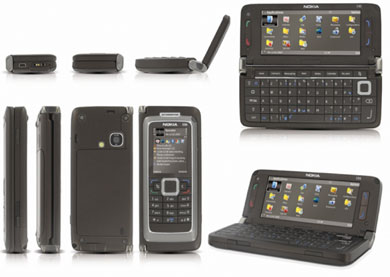
I have owned at least one of every Communicator since the brand arrived in the shape of the 9000 in … well it must be over ten years ago because I had one when I was making the film Wilde in 1996. I remember being upbraided for having it poke out of the top of my velvet jacket in one of the courtroom scenes …
What a breakthrough it was (the phone, not the film). Black and white originally, but with some very advanced features for the time. I was recording silly high quality ring tones at a time when everyone else was monotimbral, monophonic and tinkly. It was big, but it was powerful and a wonder to use. The 9 series line (running an operating system called GEOS) was slowly upgraded with the 9110 and I think another (the 9200?) until the more modern, Symbian 9500, and 9300/9300i, the latter two without camera, but smaller and neater.
And today (almost literally today) comes the E90 Communicator, a brick dressed in Symbian S60 cothes. The “E” designation is revealing. Nokia have had a dismal few years in which hardware design has faltered appallingly (my dear, have you seen the E61 and E61i? possibly the ugliest objects ever designed by man. Simply disgusting to look upon, handle or use) but another arm seems to have branched out with better design. The N95 is beautiful, really lovely and very powerful. Shame that it uses a standard telephone keypad, the N series are really multimedia toys for adolescents, aimed I would guess at the Sony Ericsson K and W series. And then there is the wholly gorgeous 8600 Luna, an indulgent chocolate-box of a mobile phone. As they say in Australia, “ideal for gift-giving interstate or overseas.”
The E series models use an especially clunky and unsightly family of icons (rather like Vodafone’s dreadful offering. If you want to uglify a Blackberry 8100 or 8800, a hard thing to do, use the proprietary V’fone theme set. Yuk. They impose it on all their badged phones and it smells). In the E61s which are so fuck-off ugly that you stretch your eyes and wonder at who on earth is running Nokia, the addition of an ugly GUI is enough to tip the whole thing over the edge. Not just an repellent concrete house, but one filled with disgusting furniture. In the case of the E90 Communicator, you have a rather pleasing house (I know, I know, beauty is in the eye of the beholder, de gustibus etc. but take it from Mother, the E90 is pleasing in exactly the way the E61 isn’t) which somehow exonerates the UI. The E90 is thick-as-a-brick, expensive (ex-contract as an offline purchase it’s well over £600. Or maybe they just saw me coming) and yet …
I LIKE IT! I really, really do. I can’t explain why. It’s the same UI, pointlessly (at first glance) doubled on both screens. No SMS threading (for God’s sake!) Yet something about the layout and something about the feel (the actual object is really strong and has a satisfyingly robust heft) pleases me and draws me to it. Functionally it works a lot more easily than the UIQ devices, on which I have so reluctantly been forced to spit. It’s hopeless with a Mac, but with a little smart to-ing and fro-ing you can transfer address books from a Mac-synced SmartPhone to the Communicator via Bluetooth, or you can bite the bullet and run the Nokia PC Suite on a PC, virtual or otherwise. (If you’re going virtual, then do upgrade to the latest version of Parallels – they are eventually starting to get USB connections right).
God knows this is NO iPhone killer. But unlike the iPhone it does have something approaching a manageable filing system, Bluetooth that works, GPS, quick text entry via a keyboard (Steve Jobs here you are wrong, much as it grieves me to say it – more below), the ability to save and move around attachments, to download applications and to create documents. The battery life is hours better than on a UIQ Sony Ericsson, the response is quicker than a UIQ Sony Ericsson too (but then the response you get from a dead walrus is better than that of a UIQ Sony Ericsson) and quicker than that of an iPhone in some arenas. All in all a Good Product. I’ve been using it solidly for two days now (in harness with an iPhone and a BB 8800) and it has that indefinable quality that marks out a device one knows one could live with. The ancient Nokia virtues from way back are there – the power button that when swiftly depressed offers profile changes as well as switch-off, the network controls, auto redialing, straightforward navigation and good old infrared (bless). To this have been added the 3.2MP camera, a videocalling second camera, amusing 3D ringtones (the only concession to teenage silliness) good WiFi (though still only 802.11b and g), USB 2.0 and Bluetooth 2.0. Yes, I like it, but – as I say – iPhone killer it isn’t. Which brings us on to the big beast.
myPhone • fryPhone • iPhone
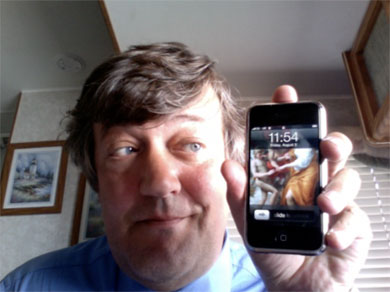
I’m not here to review the iPhone. Enough to say that in Britain at the moment, this extraordinary device remains one hell of a luxury. I have a full working model because, as a green carded US resident alien, I have an American bank account and billing address, without which AT&T authorisation would be impossible. It’s not easy after that to persuade them to allow you an international roaming account either. Until the UK release one is functionally an American in Europe roaming expensively on inferior networks. I say inferior because the UK EDGE networks are a great deal slower than the US. I have no idea why, it’s just so. My friends at Apple say there is much to be done to ready the iPhone for its projected late 2007 release over here. Perhaps it will be delayed. You see me above in my trailer, between scenes, making eyes at the device. To get EDGE in Norfolk is feat enough, believe me.
I hereby offer a few remarks – to show that I am not in Apple’s fee, and do have a totally independent way of looking at these things. There are issues. Problems. They’ve been gone over before but I’ll outline my sense of what needs looking at.
Server side apps only. No, no, no, no, no. This is NOT good. It’s one thing to want to keep the proprietary system closed, but to present a device sealed in digital Araldite is a Bad Idea. An Ubuntu flavoured Linux for mobiles is in the works, and you don’t get more open source than that. Damn it, there’s Linux for the Palm available these days. Even Microsoft are making gestures towards client-side open source apps. Only amateurs are going to want to create server side apps for the iPhone. In case you don’t know what I mean, I should explain that the only third party programs available for the iPhone are run out of Safari (the resident browser) pages. You can’t download squat. Enthusiastic individuals will come up with WorldMate or Splash Photo or other top ten smartphone app lookie-likies but until Apple introduces a Java implementation or allows the bonnet to be unwelded and lifted up, the device will remain a fraction of what it should be.
Text entry. I’m sorry Steve, but physical keyboards are okay. They’re fine. When in your iPhone introductory keynote late last year you dissed the stylus and keyboard, you may have noticed a deafening silence as tumbleweed and sage-brush whizzed through the hall. It is certainly true that the virtual kb used in the iPhone gets better the more you use it. It is also true that the glossary autocorrect system is immensely impressive. But I challenge anyone to type an email as fast on an iPhone than I can on a BB or Treo. I assure you it can’t be done. I’m pretty quick with an iPhone now, but nonetheless text entry just isn’t as satisfying as everything else about the device. It’s an example perhaps of ideology overcoming practicality, as in the early days of the single click mouse. Don’t be stubborn about this Steve, you know I’m right, as in their heart of hearts do the guys at Cupertino. Hence the lack of Quicktime movies on the Apple site showing happy users typing proper length emails and texts. Why else is the only footage of text entry hurried and very much on the short side? Because they know … they know perfectly well it’s a drawback.
Bluetooth? It might as well not be there.
D’loadable ringtones? C’mon.
Mail attachments? See and touch but can’t download? No, no, no! And yes, it should probably be 3G. A power consumption issue mostly, no doubt, but one hopes it’ll be addressed over the next few digital years.
Three months, by my reckoning is a digital year. Or to put it another way, a human year is four digital years.
But that’s about it. Everything else in the iPhone lives up to, even surpasses the hype. Another triumph for Jonathan Ive and his design team, Apple have made a wholly desirable and beautiful object. Only a cross and silly person would pretend to be unimpressed or make claims of parity about their O2 xda Trion or similar lumpen beast.
My guess is that iPhone 3 is going to be closer to the Dynabook than anyone dreamed possible. It’s a small wait by anybody’s standards. Except mine. Except the standards of the impatient early adopter.
I might as well end with a wish list.
Someone to take the UIQ platform and give a bolt of lighting. The Palm OS to receive ditto. The iPhone to open and expand. D’loadable ringtones? C’mon, Apple, you can do better than the sop you’ve thrown us with the latest iTunes release. You wouldn’t want to look greedy would you?
For me it’s an addiction. Swapping SIMS, syncing, testing, probing, playing. I can’t pretend I’ve any higher purpose. What cars are to some, SmartPhones are to me – much, much more than just a functional tool. We live in the age of these devices. It should be the age of the greatest imaginative drive, flair and creativity in the digital arena. I am disappointed that not everyone in the industry sees it that way.
As the General Confession in the Book of Common Prayer has it, “I have followed too much the devices and desires of my own heart.” Amen. © Stephen Fry 2007

Post script. The forum is also a great place to express your views